At our next meeting for 101DAO we will give and overview for using the Lifecycle Analysis Commons DBs from the US Government as a baseline in measuring Beneficial Carbon Removal or Savings. The site https://www.lcacommons.gov/lca-collaboration/
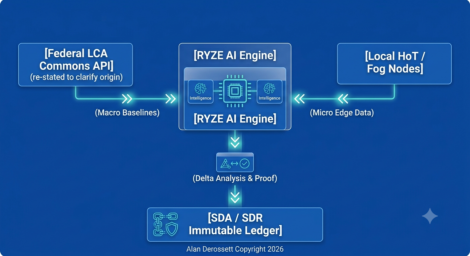

We help create Sustainable Startups
At our next meeting for 101DAO we will give and overview for using the Lifecycle Analysis Commons DBs from the US Government as a baseline in measuring Beneficial Carbon Removal or Savings. The site https://www.lcacommons.gov/lca-collaboration/
In an era defined by accelerating climate volatility and the increasing fragility of centralized communications infrastructure, standard cloud-reliant architectures are hitting an evolutionary wall. When a wildfire sweeps through a canyon, tearing down cellular backhauls, or when a massive coastal grid failure isolates a marine research facility, traditional cloud-dependent Internet of Things (IoT) systems go completely dark. The data streams required to orchestrate emergency evacuations or prevent the collapse of delicate ecosystems stop flowing exactly when they are needed most.
To overcome these existential single points of failure, a radical paradigm shift in decentralized network engineering is emerging: Fog-to-Mesh Fog Computing combined with Delay-Tolerant Networking (DTN). Operating natively across air-gapped local networks like B-LAN, this architecture forms the technical backbone for local-first frameworks such as the Angel Sharks Environmental Ecosystem and the Civic Twin Orchestra. By embedding distributed computing capabilities directly into the physical environments they monitor, these networks remain operational under total grid collapse.
This essay outlines the design, mechanics, and real-world utility of offline fog-mesh systems, examining their implementation across two critical domains: Aquaculture/Marine Environmental Digital Twins and Emergency Civic Fire Watch Systems.
The core objective of a local-first environmental or civic digital twin is simple yet structurally demanding: Zero-Connectivity Autonomy. The system must process high-fidelity spatial, chemical, and physical data, execute complex artificial intelligence inferences at the edge, and store immutable telemetry chains without ever contacting an external internet gateway or upstream cloud service like AWS.
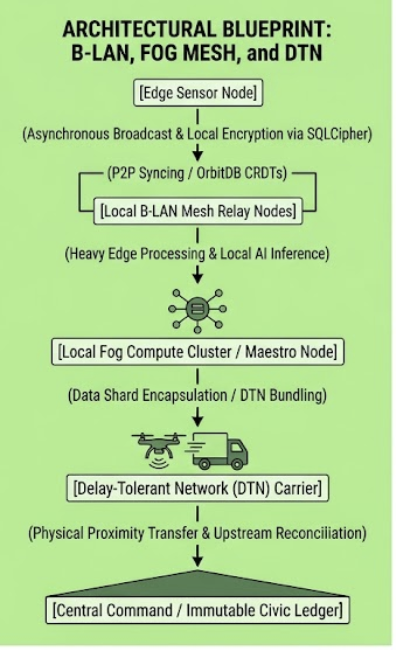
Traditional networks rely on a star topology where edge sensors speak directly to a router connected to the open web. If that backhaul fails, the system fails. The B-LAN (Backup Local Area Network) completely replaces this logic by implementing a self-healing, peer-to-peer or hybrid mesh topology natively at the edge. Using low-power, long-range wireless protocols such as spread-spectrum LoRa, Zigbee, or customized sub-GHz software-defined radios, B-LAN nodes operate as localized relays. When an individual sensor comes online, it discovers its neighbors dynamically, constructing a dynamic routing table without a central server.
Rather than treating edge devices as dumb telemetry collection points, the Mesh Fog architecture utilizes whatever localized compute resources are physically available within the mesh. Low-power single-board computers (such as Raspberry Pis, Jetson Nanos, or custom microcontrollers embedded in solar-powered buoys) form a distributed cluster. This is what the Civic Twin Orchestra refers to as the Orchestra Maestro—a local coordination layer that aggregates asynchronous sensor streams and processes heavy visual or spectral data at the edge.
To handle data state changes offline across a network with highly unstable links, the database cannot rely on traditional client-server paradigms like standard PostgreSQL. Instead, the B-LAN architecture leverages a multi-tiered offline storage strategy:
SQLite with SQLCipher: Deployed directly on individual low-power edge nodes (e.g., field sensors, underwater drones), using full-database AES encryption to protect local state logs from physical tampering.
OrbitDB on InterPlanetary File System (IPFS): Deployed across more robust Fog Compute nodes to handle peer-to-peer logs. OrbitDB uses Conflict-Free Replicated Data Types (CRDTs) to allow decentralized nodes to independently update their state tables offline and seamlessly merge their records without central coordination when they come into radio range.
While instantaneous edge processing handles real-time local logic, whole-system optimization and long-term legal compliance require matching this data with broader regional baselines. Because the mesh is air-gapped and entirely disconnected from the open internet, it communicates via Delay-Tolerant Networking (DTN) protocols.
DTN replaces the traditional TCP/IP “always-connected” model with a “store-and-forward” overlay network. Data payloads are cryptographically signed, hashed, and bundled into data shards at the edge. These shards sit securely within the localized storage layer until a mobile data mule—such as an automated aerial drone, a regional patrol vehicle, or an autonomous underwater vehicle (AUV)—passes within physical proximity. The node securely transfers the data payload via high-speed, short-range radio or physical relay. The data mule carries these bundles across physical space, eventual uploading them into the primary municipal PostGIS database or immutable blockchain ledger when it docks at a connectivity-enabled station.
An inherent risk of an offline, distributed network is data poisoning. If an adversary injects fraudulent telemetry into an air-gapped mesh, the local AI could run simulations on corrupted metrics, triggering false alarms or hiding environmental damage. Because the system cannot query an external identity provider, it relies on a strict cryptographic gatekeeper loop using native Sustainable Development Award (SDA) tokens.
The Local Authentication Loop
The Angel Sharks architecture handles edge ingestion through an air-gapped three-step process:
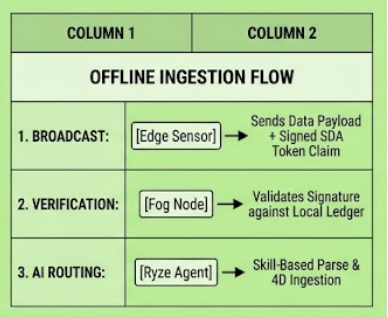
When an edge sensor comes online within a B-LAN zone, it broadcasts its raw telemetry alongside an asymmetric cryptographic signature tied to its native SDA token address. Neighboring validation nodes check this signature against a locally synced copy of the token ledger. By performing the verification math entirely within a self-hosted, air-gapped container environment, the system guarantees the origin, non-repudiation, and mathematical integrity of the sensor before its packet is allowed anywhere near the local AI model.
Once cleared, a skill-based routing agent (such as Ryze) parses the context of the data payload and structurally integrates it into the active 4D/5D Digital Twin Layer, updating the localized spatial model in real-time3. Deep Dive Use Case A: The Environmental Digital Twin for Aquaculture Farms
Aquaculture operations, such as offshore shellfish hatcheries or coastal kelp restoration zones managed by the Angel Sharks Benefit Corporation, represent highly dynamic chemical environments. Slight fluctuations in ocean parameters—such as a sharp drop in dissolved oxygen or a spike in ammonium from agricultural runoff—can destroy millions of juvenile organisms within a matter of hours
In an off-grid aquaculture deployment, a network of solar-powered smart buoys, surface stations, and autonomous underwater vehicles (AUVs) are arranged in a localized marine B-LAN mesh across the maritime lease area. Each buoy operates as a dedicated Fog compute node, equipped with:
Ion-Selective Electrode (ISE) Probes tracking Nitrate () and Ammonium () at 15-minute intervals.
Multiparameter Spectrophotometers measuring Turbidity, Dissolved Oxygen (DO), pH, and salinity.
Acoustic Doppler Current Profilers (ADCP) tracking volumetric water flow velocities ().
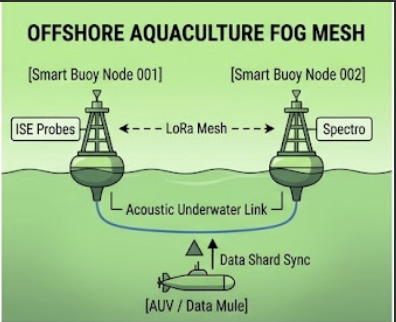
Because these buoys run off local solar arrays and independent battery banks, pushing raw data over a continuous satellite link is incredibly cost-prohibitive and energy-intensive. Instead, the heavy lifting occurs natively on the buoy using localized machine learning algorithms.
For example, a local YOLOv11 computer vision model coupled with spectral analysis reads data directly from the multi-channel spectrophotometers. Rather than simply reporting raw numbers, the model analyzes the specific spectral reflectance signatures of the water to fingerprint dissolved organic compounds and predict dangerous Harmful Algal Blooms (Red Tides) before they manifest physically in the lagoon.
By processing data locally, the fog node instantly runs the algorithmic calculation:
This metrics establishes the total constituent load of toxins traversing the aquaculture environment. Every 15 minutes, these computed insights are cryptographically hashed and appended to the local OrbitDB log.
When the DTN carrier—such as an automated surface drone—collects these hashes via physical proximity transfer, it builds an unalterable “chain of custody”. For the aquaculture operator, this acts as a legal liability shield. If toxic industrial runoff kills their crop, the immutable, time-stamped ledger proves exactly when and where the external pollutants entered their maritime lease boundaries, creating audit-proof evidence for environmental enforcement actions.
In suburban and urban-wildland interfaces—such as the Conejo Valley, Thousand Oaks, and Westlake Village regions—wildfires represent catastrophic infrastructure threats. When a major fire is ignited, commercial cellular towers and fiber backhauls are often the first elements of critical infrastructure to burn down, leaving emergency services completely blind precisely as an evacuation scenario develops. The Civic Twin Orchestra leverages an offline Fog-to-Mesh infrastructure to completely eliminate this vulnerability.
In a resilient municipal deployment, critical urban assets—such as the 10-15 smart traffic signals and hundreds of environmental sensors covering a city like Westlake Village—are converted into self-contained B-LAN fog nodes. Each signal is outfitted with low-power microcontrollers running lightweight edge AI (such as TensorFlow Lite) and backed by dedicated solar panels and independent lithium-ion battery arrays capable of maintaining full operational status for 24 to 48 hours without grid power.
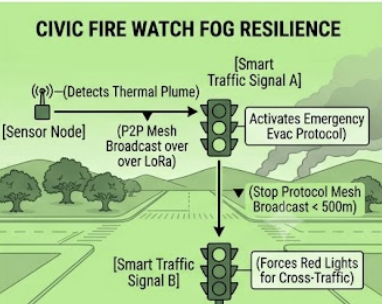
When commercial internet networks go completely dark, these nodes do not stop functioning. Thermal infrared sensors and optical chipsets positioned at the urban boundaries scan the landscape continuously. If a wildfire breaks out, individual edge nodes detect the immediate thermal plume or localized PM2.5 smoke spikes.
Instead of routing a massive data stream to a non-existent cloud server, the nodes run predictive multi-physics simulations locally. They cross-reference the live sensor detections against a locally cached 3D baseline map of the city’s terrain and utility infrastructure. The local AI instantly models disaster vectors, calculating the fire’s speed and trajectory based on real-time wind and temperature metrics gathered natively within the mesh network
As the fire vector models identify which streets will become evacuation bottlenecks, the localized mesh activates defensive infrastructure responses autonomously via a Stop Protocol Mesh Network.
When a first responder vehicle (fire engine or ambulance) approaches an intersection, its onboard mesh transponder broadcasts a prioritized cryptographic identity token across the short-range radio network. The approaching smart traffic signal validates the identity via its offline ledger, executes local fallback decision logic, and actively forces a red light on conflicting directions while holding a green light open for the evacuation corridor.
By pushing commands directly over a short-range mesh, the network eliminates cloud latency and provides reliable traffic orchestration even when the central municipal command center is physically cut off from the city.
All events, traffic adjustments, and fire vector tracking details recorded during the communication blackout are bundled into secure data shards within the local OrbitDB registry. As aerial firefighting drones or emergency coordination vehicles move through the disaster zones, they collect these logs using DTN protocols.
Once connectivity is re-established at a primary resilience hub, these bundles are synchronized back into the central database. To reconcile the intense computational energy expended by many of edge clusters during the crisis, the city’s system runs the G-Air Algorithm. The algorithm reviews the data shards collected over the DTN, analyzes the carbon footprint of the event, and schedules heavy, non-time-sensitive municipal utility calculations during the exact hours of the following weeks when local solar availability is at its highest and grid carbon intensity is at its lowest. This ensures that even during extended disaster response operations, the city strictly maintains its long-term carbon-negative operational mandate.
The integration of Fog-to-Mesh computing, air-gapped B-LAN topologies, and Delay-Tolerant Networks represents a fundamental evolution in how we construct digital twins for critical environments. By moving away from brittle, cloud-dependent architectures, systems like the Angel Sharks platform and the Civic Twin Orchestra prove that high-performance AI monitoring and automated system optimization do not require a connection to the open internet to be effective.
Whether calculating the real-time mass loading rates of a remote aquaculture farm or driving autonomous traffic evacuation patterns during a catastrophic wildfire, offline fog networks ensure that data collection, analytical inference, and operational execution remain completely unbroken. By grounding data validation in native, edge-computed cryptographic handshakes, these systems establish an audit-proof layer of trust that protects municipal and private operators alike.
“As climate impacts continue to test the limits of our centralized systems, the future belongs to networks that can think locally, act autonomously, and endure indefinitely—completely off the grid. “Alan DeRossett
Announcement: Sustainable Development Awards Governance Meeting
We are excited to convene our community for the upcoming Sustainable Development Awards (SDA) Governance Meeting. As a token holder, your voice is essential in shaping the future of our impact initiatives and ensuring the longevity of our mission.
Event Details
Date: April 4th, 2026
Time: 10:00 AM — 12:00 PM UTC
Location: Virtual (Link provided upon registration)
Eligibility: Open to all SDA Token Holders
Agenda Highlights
The meeting will focus on key strategic decisions and the allocation of resources for the upcoming fiscal year:
Project Milestone Review: A deep dive into the impact metrics achieved by our current award recipients.
Treasury Management: Discussion on the proposed budget for the Q3-Q4 2026 grant cycle.
Voting Protocol Updates: Reviewing proposed changes to the $DAO$ governance smart contracts to improve proposal efficiency.
Open Floor: A dedicated session for token holders to introduce new sustainable development initiatives.
Note: To participate in live voting during the session, please ensure your tokens are held in a non-custodial wallet compatible with our snapshot tool.
Hot replaces the Internet of things for Home of Things now your home Fog network can use AI offline to operate your home. No more worries of a security breach in Cloud networks. In 2026 the AI breakfast will discuss deployment of your own Meshtastic Fog servers using the DTN protocol. Your Home of Things can now use exclusively solar for its AI compute jobs offline.

Next Tuesday we will be conducting simulations in SDA creation with Solar panels And Refine its Algorithm
The core unit of reward is the SDA Watt, which is a token tied used to verifiable sustainable energy production via Proof of production. Once a watt is produced a smart contract must be signed via a proof of Authority like a Smart meter. a Verified Watt produced using an SDA can now be used to issue a Sustainable Development Reward that can be traded across a bridge as an asset.
See next Tuesdays, December 2nd meeting notes for simulation results we will sim a 10,000 Watt Home panel system with home Battery to use the power directly for a EV earning the home user the maximum SDR watt value.
The 101DAO is holding a meeting of its Delegates to discuss Governance issues and its Transition from a Web3 Utility token into a full Web4 Architecture. The informal meeting will be a brain trust to propose new Web 4 initiatives to Virtual world and Human AI digital representation of real-world entities. Like predictive Digital twinning will provide.
Announcing the 101 DAO Sustainable Development Awards
101 DAO is proud to announce a groundbreaking initiative: a 7.5 billion Utility Token award dedicated to advancing sustainability through technology. This award is designed to support projects that use AI monitoring of remote sensors within Digital Twin AI Presence and Prediction Systems.
We believe that true sustainability requires verifiable, data-driven solutions. These utility tokens will power a system that creates an immutable ledger for the auditable tracking of sustainability goals. This includes ambitious objectives like carbon removal in complex environments and the development of planet-scale environmental infrastructure projects, such as off-grid energy generation.
Unlike traditional cryptocurrencies that rely on proof-of-work, the 101DAO Sustainable Development Awards utilize a unique proof-of-production model. New tokens are created only when a verified sustainability goal is achieved. For example, a project that produces 1 watt of energy, verified by a smart meter, automatically triggers a smart contract. This converts the underlying SDA into a Sustainable Development Project Reward. This award can then be recycled or reused on a private, offline sidechain to increase its production potential before being transitioned to a main chain by Q3 2026, where it will function as a store of value.
This model ensures that our tokens are directly tied to real-world, measurable progress toward a sustainable future. We are excited to see the innovative ways our community will leverage this award to build a better, more sustainable world. Q3 2025 Award was Made To Angel Sharks Benefit Corp. A Sustainable Development parter and former XPRIZE Carbon Removal Completion Team.
Store of Value: By Q3 2026, the award will become a stable, long-term asset.

Our AI Breakfast meetings began in 2014 with in-person Breakfast usually in the 805 Area code by Alan DeRossett and Pedro V. Marcal who is widely recognized for his pioneering work in the development and application of finite element methods for nonlinear problems, particularly in plasticity and structural mechanics.. As an Author, Pedro has over 100 papers published and worked closely with Dr, Jeffery Fong of NIST. The early collaboration into ML/AI came from an online Stanford course by Sebastian Thrun on Autonomous Vehicles. Pedro also helped compute the Voxels for 2 sets of 2 d X-rays on a VOXearch project to help people who had ferrous metal Heart Monitoring Leads implanted surgically in error to Dr. Alfred Mann’s original design for Heart pacemakers. This early work helped create a virtual 3d model for surgeons to use in replacing the recalled heart pacemaker leads. The focus of our next AI collaboration came out of the TRICORDER XPRIZE competition, team VOXearch. Up until then, all Our ML/AI had been physics-based. Others at those First AI breakfast meetings included Allan Grovesner who would later start MSB.AI and Wilson Hago one of the winners of the NASA CO2 challenge to convert CO2 into sugar aboard the ISS on Aug 24, 2021. During the interruption known as Covid, we expanded the meetings too online to include others in the medical pioneering field like Marc Mathys then working at the University of Marburg, Germany. This new format will be live-streamed on Linkedin . Fast-forward to Week 269 and Alan DeRossett will be discussing Angel Sharks AI used with remote sensor data to compute AI in Fog networks for the Marine restoration and Aquaculture industry. A new Crypto will be deployed to work offline as a side chain to bring an immutable ledger and trusted data to Angel Sharks new AI digital Twins modeling service called AquaGIS
AI Breakfast on June 3, 2025, will be week 269
We will hold this meeting on Zoom Live next week to also discuss new developments in AI, especially the New Chinese Data Center deployment into Space to use unlimited 24/7 Solar energy. Please RSVP to Events@101incubator.com for the Zoom link.
New AI-generated videos from this tool Meta has created it creates short Videos from your Text prompts. https://makeavideo.studio/
in the next two weeks, we will highlight some of your best examples send us your examples to info@101incubator.com
The field of artificial intelligence (AI) is advancing at a breakneck pace, with new breakthroughs and innovations being announced almost every week. However, some weeks are more eventful than others, and the past week has been one of the most significant in recent memory. In this blog post, we’ll take a look at some of the most important developments in AI from the past week.
GPT-3’s successor
OpenAI, one of the leading AI research organizations, announced that they are working on a successor to their groundbreaking language model, GPT-3. GPT-3 is already one of the most advanced AI systems in the world, capable of writing articles, composing poetry, and even coding programs. Its successor, known as GPT-4, promises to be even more powerful and versatile, with the potential to revolutionize a wide range of industries.
New AI chip from Intel
Intel, one of the largest chipmakers in the world, unveiled a new AI chip called Ponte Vecchio. The chip is designed to handle the complex computations required for AI and machine learning, and it promises to be one of the most powerful AI chips on the market. Intel hopes that Ponte Vecchio will help them compete with other chipmakers like Nvidia, which currently dominates the AI chip market.
AI-powered healthcare
AI is already being used in healthcare to diagnose diseases, develop new treatments, and improve patient outcomes. However, the past week saw several new developments in this area. For example, researchers at Stanford University developed an AI system that can predict whether a COVID-19 patient will require intensive care, based on data from their medical records. Meanwhile, Google Health announced that they are developing an AI system that can help doctors detect breast cancer more accurately and quickly.
AI in space exploration
AI is also being used to explore the universe, with several new developments in this area over the past week. NASA announced that they are using AI to help design a new spacecraft that will be able to explore the outer planets more effectively. Meanwhile, researchers at the University of California, Berkeley, used AI to analyze data from the Kepler telescope and discovered a new exoplanet that had previously been overlooked.
These are just a few examples of the many exciting developments in AI that took place over the past week. From healthcare to space exploration, AI is transforming our world in countless ways. As technology continues to advance, it’s clear that we can expect even more exciting breakthroughs in the near future.